
Part 2
The Pursuit of “More”
Every cyclist wants to see that FTP number climb.
330. 340. 350. It’s intoxicating.
But after years of chasing it, I discovered the hard truth: sometimes, more power on paper means less power in the race.
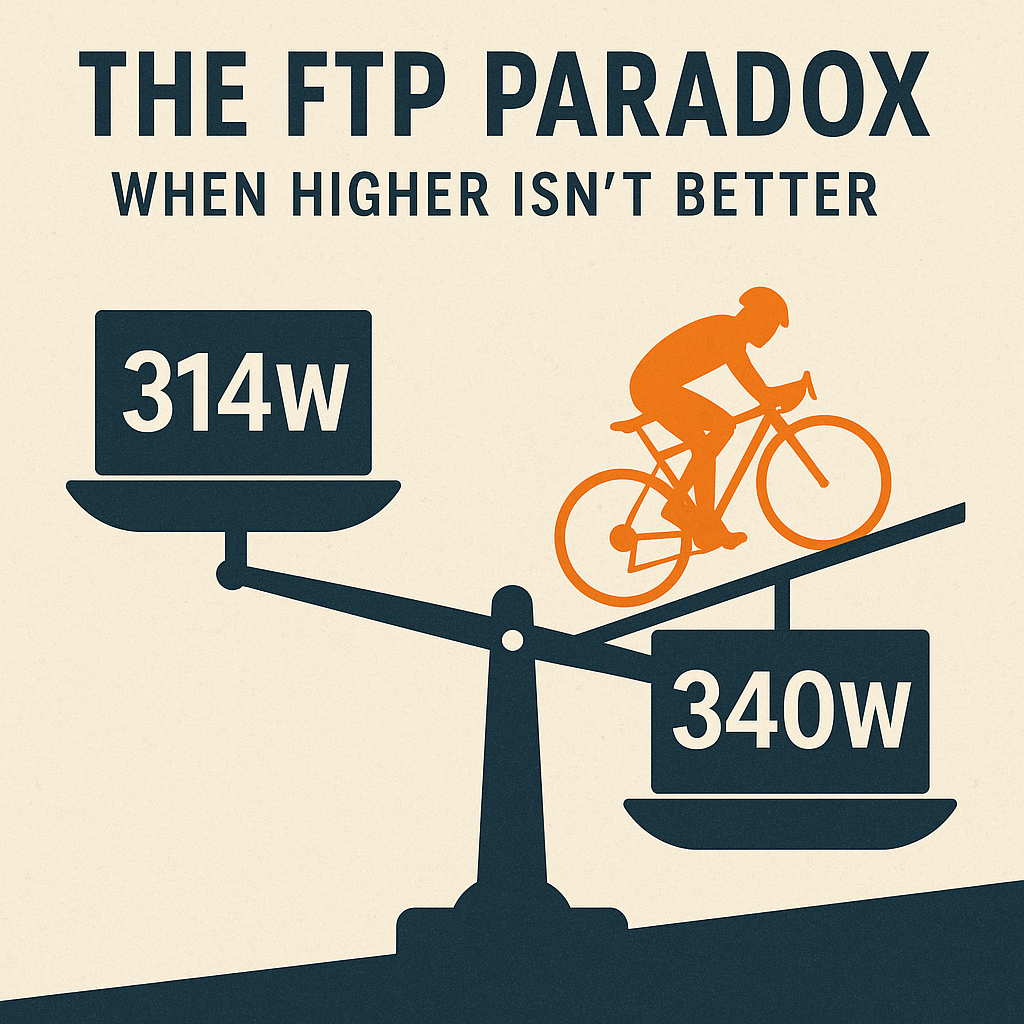
In 2021–2022, my FTP was testing around 335–340W, and I felt strong — in short tests.
But in real races, that strength collapsed. One big surge, and I’d be flooded.
I could hit 450W for a minute, but I couldn’t clear it.
It wasn’t fatigue. It was physiology.
I had built a high FTP the wrong way — through a glycolytic bias that looked powerful but wasn’t durable.
When FTP Gets Too “Expensive”
A higher FTP isn’t automatically better if it comes from the wrong energy system.
In metabolic terms, FTP = the intersection of your aerobic capacity (VO₂max) and glycolytic capacity (VLamax).
- Raise FTP by boosting aerobic power → durable, low-cost watts.
- Raise FTP by boosting glycolysis → brittle, high-cost watts.
On paper, both FTPs look the same.
But one gives you depth; the other gives you drift.
When my VLamax was high, my lactate skyrocketed in threshold tests.
Even 4–5 mmol readings at 310–315W — meaning I was sitting in the red zone while thinking I was “just below threshold.”
No wonder I was fading in races after 90 minutes.
The Science of Stability
Elite endurance performance isn’t about the biggest number — it’s about the lowest cost per watt.
That’s why the Norwegian model, the Inscyd framework, and the Couzens durability approach all converge on one principle:
“A lower-lactate, high-clearance threshold beats a high-lactate, high-cost one.”
Think of FTP like an economy:
- The aerobic system is the income stream.
- The glycolytic system is the credit card.
If you keep swiping, you look rich — until you can’t pay the bill.
The pros you envy on Strava? Many ride and race with “lower” FTPs than they could test in the lab.
They intentionally keep glycolysis suppressed to maintain repeatability — the ability to go again, and again, and again.
When I Lowered My FTP — and Got Faster
In 2025, I stopped chasing the number.
I shifted focus to:
- FatMax and Zone 2: long rides at 240–265W to harden the aerobic engine.
- Tempo and Sweet Spot: improving metabolic stability.
- Surge-and-Clear: teaching my system to process lactate under load.
My test FTP dropped slightly — from ~335 to 314W.
But my usable power exploded.
- I could now hold 330W after 2.5 hours of racing.
- I recovered faster from anaerobic spikes.
- Lactate at 305W fell from 5.0 to 3.4 mmol/L.
That’s when I realized:
I hadn’t lost power — I’d unlocked it.
The Paradox Explained
A lower, truer FTP means you’re running on clean fuel.
Less lactate, more clearance, more repeatable power.
It’s why athletes like Blummenfelt, Pogacar, and top-level time trialists train sub-threshold endlessly. They’re not afraid of smaller numbers because they understand the hidden metric that matters most:
lactate cost per watt.
The next time your FTP test comes back “disappointing,” ask:
- Am I more repeatable?
- Can I surge and clear better?
- Can I hold higher watts deeper into fatigue?
If yes — congratulations. You’re faster, not weaker.
From the Lab
The data doesn’t lie.
My May test:
- 209W @ 138 bpm = 1.0 mmol/L
- 234W @ 146 bpm = 1.0 mmol/L
- 264W @ 157 bpm = 1.8 mmol/L
- 297W @ 168 bpm = 3.3 mmol/L
- 330W @ 175 bpm = 5.2 mmol/L
That’s a metabolic system finally working with me, not against me.
And it’s why I can now win races with an FTP lower than my lab peak — because it’s no longer a number, it’s a foundation.
Takeaway
Higher isn’t always better.
A lower FTP with cleaner metabolism means more control, more speed, and more wins.
Don’t chase the number — chase the system that lets you use it.
Part 1: FTP Isn’t A Ceiling, It’s A Launch Pad
Next up: Part 3
Fuel your next breakthrough. Don’t miss new insights, workouts, and the launch of SMART Cycling
Leave a Reply