
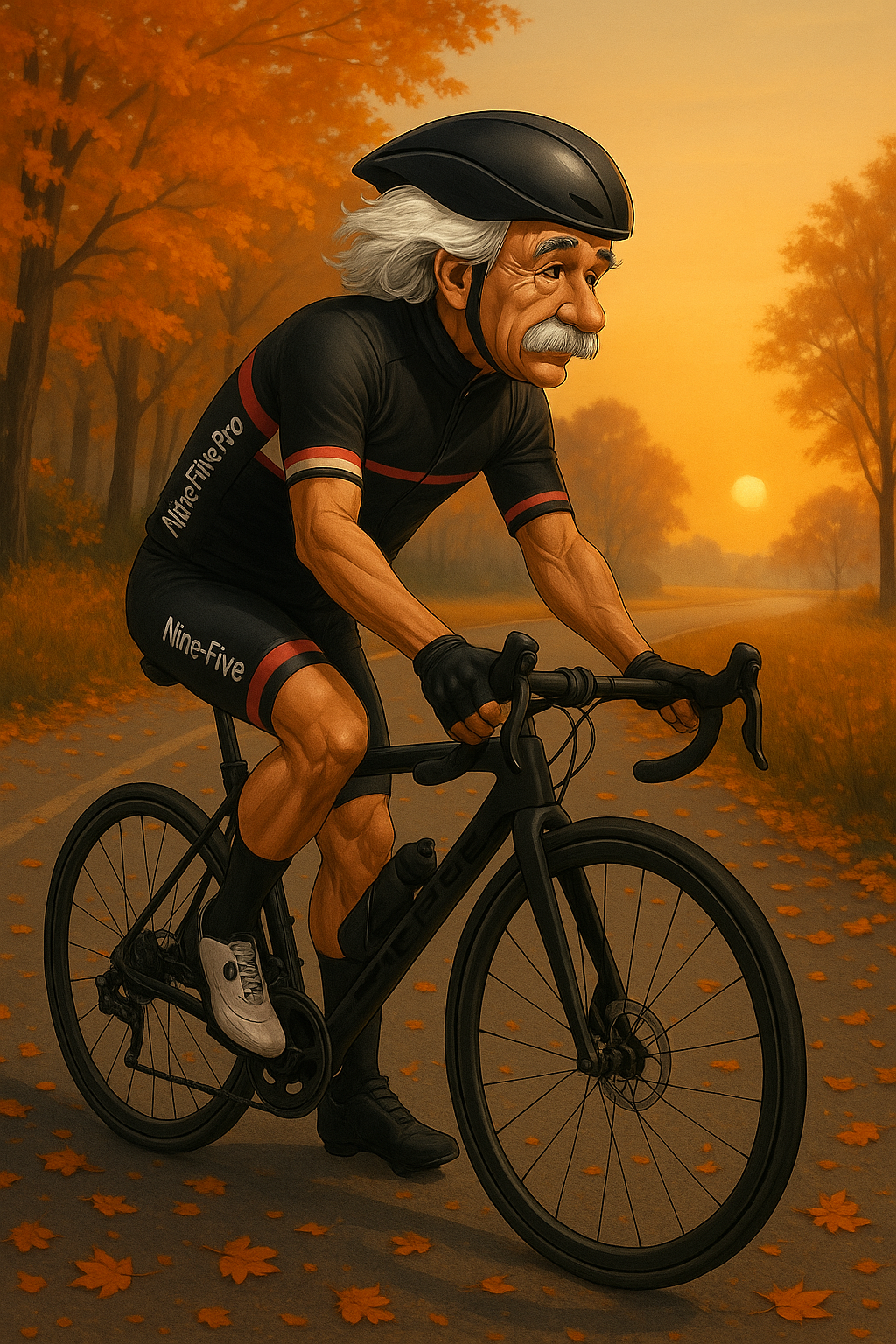
Every fall, the same message starts circulating through Masters cycling circles:
“You can’t afford to take too much time off.”
The reasoning sounds logical — “Older athletes lose fitness faster,” “it’s harder to rebuild base after 40,” or “you need to keep the engine running.”
It’s become an accepted truth in modern endurance culture: that the 40-plus rider must always keep moving, always maintain some intensity, and never fully step away.
But that belief isn’t rooted in physiology.
It’s rooted in fear.
The Contradiction No One Wants to Admit
The same physiologists who remind us that recovery slows with age often say Masters athletes can’t rest as long.
That’s a contradiction.
You can’t claim recovery is harder and then recommend less of it. That’s like telling a sleep-deprived person to nap less.
If recovery takes longer, you need more of it — not less.
Yet the prevailing message to Masters riders is: “Stay active. Keep a bit of intensity. Don’t let fitness slip.”
And year after year, those same riders hit February feeling flat, wondering why the form they expected never shows up.
The Hormonal Reality of the 40-Plus Athlete
The biggest difference between a 25-year-old and a 45-year-old isn’t discipline — it’s hormonal and cellular recovery rate.
- Testosterone & growth hormone decline, slowing tissue repair.
- Cortisol clearance drops, so you linger in catabolic mode longer.
- Inflammation runs higher, making connective tissue slower to heal.
- Mitochondrial turnover slows, so the aerobic system needs more time to adapt.
When a Masters athlete trains like they’re 30 — same pattern, just “a bit less volume” — it’s a mismatch.
The limiter isn’t work capacity. It’s recovery capacity.
Physiology doesn’t reward that mismatch. It punishes it.
The Myth of ‘Losing It’
Here’s the fear that drives it all: “If I stop, I’ll lose everything.”
But fitness isn’t a light switch. Aerobic enzymes and capillary density fade slowly. What drops fastest is neural sharpness — the snappy coordination between brain and muscle — and that comes back within days once you resume structured work.
What doesn’t rebound quickly is hormonal balance if you never let it reset.
A three-week transition might cost 3–5 percent of aerobic conditioning, but it restores the 20 percent of recovery capacity you’ve been missing for years.
No one loses a season from taking a break.
Plenty lose seasons from never taking one.
The Fallacy of Year-Round Intensity
Modern coaching culture loves the idea of “micro-intensity maintenance.”
Even during transition, riders are told to “sprinkle in a little tempo or VO₂.”
That sounds harmless, but it keeps stress hormones elevated.
Intensity is a hormonal event: adrenaline, cortisol, and catecholamines surge to drive performance. In younger athletes those systems rebound quickly; in older ones, they don’t.
If you’re always slightly on, your body never shifts into true regeneration mode. You don’t just lose freshness — you lose responsiveness.
You can still hit numbers, but the body stops learning from them.
By Trying to Keep Fitness Alive, You Kill Adaptation
When you constantly top up with intensity — the “just a little bit” mindset — you’re not training anymore; you’re stimulating your nervous system for reassurance.
Each interval spikes adrenaline and dopamine. It feels amazing. For a few hours, you feel alive again — legs firing, ego restored.
But that sensation isn’t progress; it’s chemistry.
Twenty-four to forty-eight hours later, you’re flat again.
So you go back for another hit — another group ride, another set of openers, another “just needed to feel it.”
That’s not development. That’s self-medication through effort.
You Don’t Just Lose Freshness — You Lose Responsiveness
When you train through fatigue long enough, you don’t fall apart — you just go numb.
You’re still functioning, still riding well enough that no one notices. But the system’s quietly stale.
It looks like this:
- You can hit good power, but heart rate barely moves.
- You finish hard rides feeling fine, not fulfilled.
- You sleep, but wake up unrefreshed.
- Easy rides feel oddly heavy.
- Caffeine becomes a daily crutch.
- You toss in more intervals mid-week because you “need to open up the legs.”
You tell yourself, “I’m not tired — I just need to push.”
But that “push” is what keeps you stuck.
You’re living in a constant sympathetic loop: over-stimulated, under-recovered, and confusing arousal with adaptation.
If You’re Nodding But Thinking ‘That’s Not Me’…
That’s exactly who this is for.
Because most Masters riders don’t look burnt out — they look fine. They’re just flat.
Their metrics haven’t collapsed; they’ve just stopped improving.
Ask yourself:
- Are your best powers this year the same as last year?
- Do your legs feel okay, but never quite “pop”?
- Does motivation spike only when you chase a Strava PR or group-ride duel — then fade the next day?
- Are you chasing more stimulation than development?
If that sounds familiar, you’re not lazy. You’re just living in low-grade fatigue — not enough to crash, not enough to grow.
Chasing Stimulation vs. Building Development
That quick dopamine hit from a brutal session or a leaderboard battle feels like proof you’re still sharp. It’s addictive.
You might be exhausted from work, underslept, over-scheduled — but you still think, “If I smash some intervals, I’ll feel better.”
And for a moment, you do.
But that rush is just adrenaline and dopamine. It’s a chemical illusion of progress.
Twenty-four hours later you’re drained, mood flat, HRV in the basement. So you chase the feeling again.
It’s not training anymore — it’s chasing stimulation to mask fatigue.
The problem isn’t effort; it’s intent.
You’re training to feel something, not to build something.
The Trap of ‘Feeling Old’
Here’s the subtle danger: when you live in that loop long enough, you stop calling it fatigue — you start calling it aging.
You hear it everywhere:
“I just don’t bounce back like I used to.”
“Takes me longer to warm up now.”
“That’s what happens after forty.”
But fatigue doesn’t have an age.
I’ve felt the exact same way at 16, 25, 35 — that dull heaviness, the lack of spark. That’s not age; that’s fatigue. The only difference is that now I have the wisdom to recognize it for what it is.
When you label it as aging, you stop questioning it. You start accepting the plateau instead of asking why it’s there.
I have close friends — brilliant riders — still performing at a high level, but quietly tired. Not broken, not burnt out, just running on constant low-grade fatigue and calling it “getting older.”
I’m not judging them. I’ve been that athlete too: tired, telling myself, “Let’s add intervals.” I’d feel amazing after — for a day — then wrecked again by mid-week.
That wasn’t progress. That was stimulation.
It took me years to see the difference.
The Real Marker of Aging Isn’t Decline — It’s Denial
You can’t stop biology from changing, but you can control how you respond to it.
The body still adapts beautifully — it just needs longer between doses of stress.
“Feeling old” is often just your system saying, “I’ve been running on fumes — give me space to breathe.”
The smartest Masters riders — the ones still improving into their fifties and sixties — aren’t trying to act young. They’re managing fatigue so precisely that they never confuse it with age.
A New Kind of Confidence
Taking time off doesn’t mean you’re soft. It means you trust the process enough to stop forcing it.
That’s a different kind of confidence — quiet, grounded, earned.
Real progress after forty isn’t about proving you can still suffer. It’s about building a system that keeps adapting year after year.
And that requires space — not stimulation.
When you finally stop chasing the feeling of fitness, you rediscover the joy of building it.
Redefining Consistency
Consistency doesn’t mean training every day.
It means repeating the right pattern over years: stress → adapt → recover → reset.
If you skip the reset, you’re not consistent — you’re just surviving.
So when someone says, “Masters athletes can’t afford to take a long break,” remember:
You can’t afford not to.
Without recovery, you’re not maintaining fitness — you’re maintaining fatigue.
Final Thought: Train Less, Adapt More
Masters athletes often say, “I can’t train like I used to.”
That’s true — but not because you’re weaker.
It’s because you’re wiser.
You’ve learned that performance isn’t just about doing work; it’s about absorbing it.
And absorption requires space.
The best riders over 40 aren’t the ones who keep grinding.
They’re the ones who’ve mastered the art of strategic stillness.
Rest isn’t regression.
It’s what allows evolution.
Fuel your next breakthrough. Don’t miss new insights, workouts, and the launch of SMART Cycling.


Leave a Reply to ronfamosCancel reply