
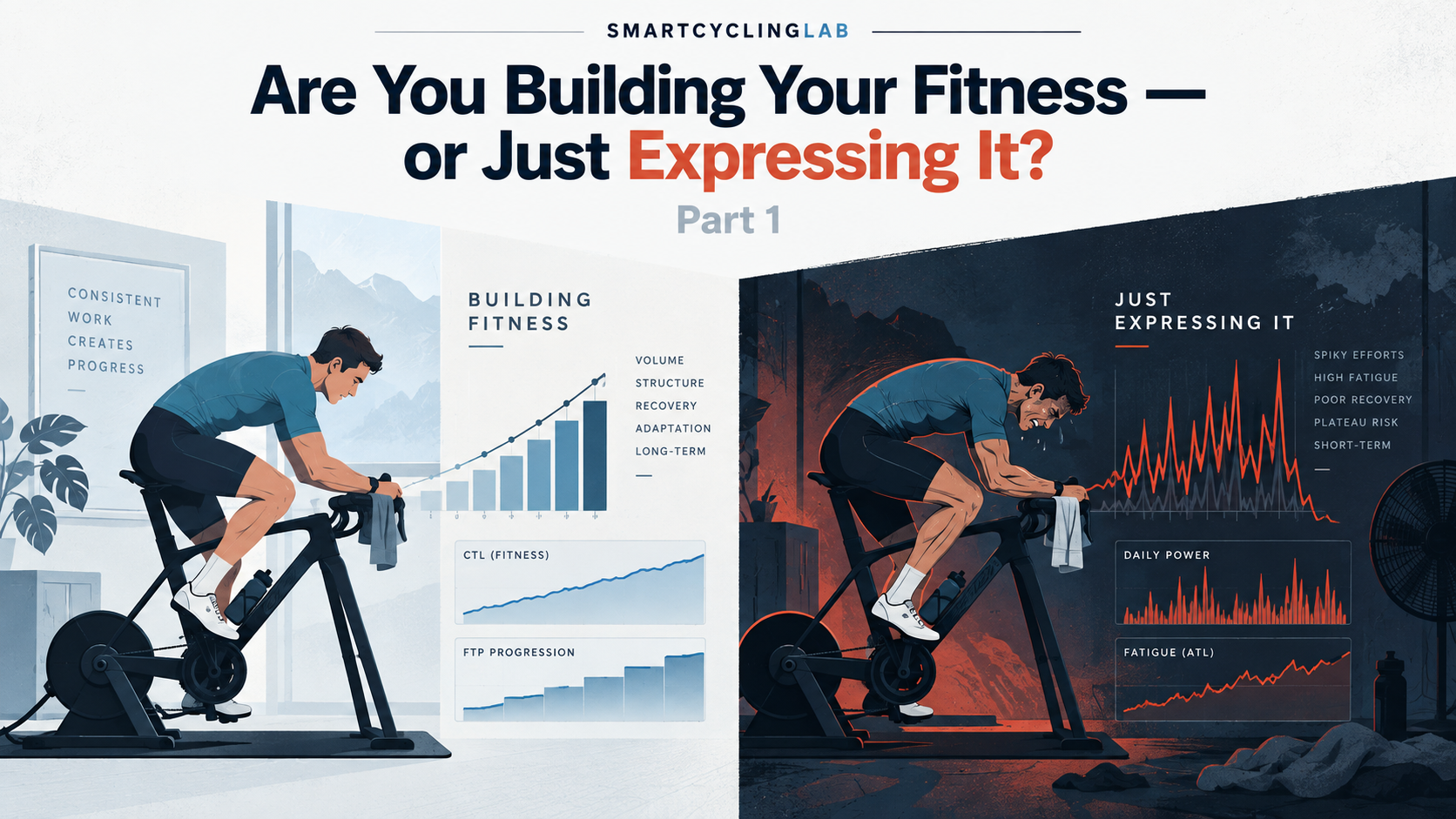
One of the biggest mistakes I see with cyclists—particularly self-coached cyclists—is also one I caught myself making this year.
And it’s not the first time I’ve made this mistake.
You’d think that after 30 years of training, I’d know better. I suppose the journey toward self-discovery remains a lifetime objective.
What is this mistake? And is it costly?
The answer is yes.
And the mistake is simple yet complex:
We spend too much time expressing our fitness and not enough time building it.
Why do I say it’s simple yet complex?
Because those two things can look remarkably similar in a training file.
A hard 20-minute effort can be called threshold training. Three-minute intervals can be labeled VO₂max. A fast group ride can be justified as quality aerobic work. Thirty-fifteen intervals can look exactly like the workout your coach prescribed.
But the file doesn’t always tell you what the workout really was.
There is a more important question:
Was that session designed to create an adaptation — or was it really an opportunity to demonstrate what you could already do?
The distinction matters.
How and when you place a session in your training calendar matters.
How you execute it matters.
And I think self-coached athletes get it wrong far more often than they realize.
I certainly have.
And I definitely did this year.
When Training Quietly Becomes Testing
Many cyclists are attracted to numbers.
I know I am.
Of course, that wasn’t always the way.
There was a time I lived by rules and chased feelings. It felt constrained at the time, but given the world we live in today, it was filled with much more freedom and play.
Still, I love numbers, and so do many of the cyclists I train and coach.
If I had to choose an era to grow up in—the one I did or today—I’d pick today every single time.
Numbers, data, training software, and specifically power meters have transformed cycling training because they give us an objective way to prescribe and measure work.
But the same tool that helps us control training can also tempt us to turn every workout into a performance test.
If you’re like me, you may love the feeling of performing.
It can feel like personal growth, excelling, and getting ahead.
Those feelings are quietly—or perhaps not so quietly—addictive.
And that is where training can begin to drift.
What started as a session designed to create adaptation slowly becomes a session designed to prove something.
How Does It Look?
Let’s say your FTP is around 315 watts.
Productive training for threshold work could be between 277 and 300 watts.
Over a few weeks of total training stress, repeating threshold at these levels is not only highly productive, it’s more than likely desirable.
But somehow, after achieving time in this range, athletes tend to feel less productive than riding at 320.
Why?
Because 320 feels more like performance.
It feels closer to the number we associate with our fitness.
It feels harder.
And therefore it feels better.
The same thing can happen once you can survive three minutes at 380 watts doing your VO₂ work.
Suddenly, 350 or 360 watts can feel like you are leaving something on the table—despite the fact that this lower range may be exactly where VO₂ plateaus and the stimulus you need to continue to move your ceiling upward, rather than 380 watts, which leans heavily on anaerobic capacity.
The number chasing doesn’t stop there.
If your 30-second power is enormous, why would you do 30/15s at 370 watts when you can hit 430 or 450?
So we push the numbers upward.
- The threshold workout becomes 315, 320, 323 watts.
- The VO₂ workout becomes 380 watts instead of 350.
- The 30/15 session becomes 430 or 450 watts instead of a controlled aerobic interval session.
And when we complete the workout, we feel successful.
The file looks impressive.
But impressive and productive are not necessarily the same thing.
Sometimes what we’ve really done is work the wrong system we’re trying to improve.
We’re putting out our best numbers and hitting our best workouts.
We’re racing ourselves.
And in the process, we’re adapting sub-optimally, plateauing, and perhaps feeling flat.
I Did Exactly That This Year
It’s fall, so it’s time to reflect on what I did right this year, but also what I did wrong.
Looking back at my own training, I now think a lot of what I called threshold training was really sustained race effort.
I regularly performed 15- to 25-minute efforts around 315–323 watts.
I could do them.
And I could do them week in and week out for many weeks.
That was part of the problem.
Because I could complete the work, I assumed the training was appropriate.
But there is an enormous difference between being capable of doing a workout and that workout being the best way to create an adaptation.
Those sessions were costly.
They required concentration.
They hurt.
They produced substantial fatigue.
They often felt more like something I had to get myself “up” for than routine training.
Psychologically, they started taking something from me as well.
Training became harder to get excited about.
Just ask my training partners: I sounded like a broken record, constantly talking about how tired I was this season and how much napping I was doing.
I think I mentioned having RED-S multiple times.
I wanted to blame fuelling rather than admit I couldn’t train or hit the numbers the way I wanted and recover appropriately—with sufficient energy to complete daily tasks.
Honestly, too many important sessions came with an implicit test:
- Can I still hold 320?
- Can I do 380 watts again?
- Can I beat the number I did two weeks ago?
- Can I finish the last interval at the same power?
That changes your relationship with training.
Instead of asking:
What adaptation am I trying to create today?
You start asking:
What performance can I produce today?
Those are not the same question.
One builds toward something.
The other continually asks for evidence that the thing already exists.
I think I spent too much of this season expressing fitness.
And eventually, I paid for it with motivation, consistency, and, I believe, some of the fitness I was trying so hard to build.
In fact, I’d argue I trained myself to suffer.
I didn’t technically build fitness.
I didn’t become a V12 Lamborghini.
I remained a Toyota Yaris, pushing it to its limits.
The Hardest Workout Isn’t Automatically the Best Workout
This is where training gets counterintuitive.
Exercise has to create stress to produce adaptation.
It also has to be somewhat precise—within the guidelines of the exercise physiology knowledge we possess today.
Coloring outside those lines, riding on the very edge of an athlete’s current capabilities or test numbers without taking total stress into account, can and will be detrimental.
Adaptation is not linear.
And more stress does not automatically produce more adaptation.
In fact, excess stress can work the wrong bioenergetic system, leaving the one you actually want to improve underdeveloped.
At some point, the additional stress simply increases recovery cost.
The relationship is not:
More suffering = more fitness.
It is closer to:
Enough stress + enough recovery + repetition over time = adaptation.
That distinction has been hiding in successful endurance training systems for decades.
Sadly, most self-coached athletes gloss over it.
Instead, they are drawn to mantras like:
“Work harder.”
“Just ride your bike more.”
“Harder is better.”
The “more” mentality will always draw a bigger crowd than “optimal.”
And for good reason.
Optimal can sound too convoluted, too oblique, or too hard to judge.
But is it?
I would argue cycling and most endurance training have very established frameworks in place.
Yet many self-coached athletes—and even coaches—want to color outside those lines, doubt the established principles, or constantly test the boundaries.
Stephen Seiler’s early work describing elite endurance athletes found that they performed a very large percentage of their training at low intensity, with comparatively little time in the middle intensity range.
In one study of competitive cross-country skiers, roughly three-quarters of endurance training was performed in the lowest intensity zone.
However, we shouldn’t rely on only one researcher’s conclusion.
Nor will we.
Subsequent research has shown that elite endurance athletes don’t all use one identical model.
Some programs look polarized.
Many are better described as pyramidal.
Training distribution also changes through the season.
Regardless, there is a striking commonality among top researchers, past and present coaches, and newer training methods:
A lot of training is deliberately kept inexpensive.
That matters more to this discussion than whether an athlete is technically polarized or pyramidal.
The successful athlete isn’t trying to make every session maximally stimulative.
The athlete is trying to create the largest useful training process they can recover from.
That is very different.
And perhaps that is the real lesson.
The goal is not to prove fitness every week.
The goal is to build a training process that quietly creates more of it.
Coming in Part 2
In Part 2, we’ll look at some of the training models, coaches, and methods that deliberately control intensity to create adaptation rather than constantly test performance.
We’ll look at why successful systems often keep hard work more restrained than athletes expect, how intensity can be distributed across a season, and why training that feels almost too easy on certain days may be exactly what allows the important work to actually work.
Because the real question isn’t:
How hard can I train today?
It’s:
What kind of athlete am I trying to become months from now?
Fuel your next breakthrough. Don’t miss new insights, workouts, and the launch of SMART Cycling.
Leave a Reply