
Most training mistakes aren’t made by beginners.
They’re made by experienced cyclists doing what feels familiar, disciplined, and responsible.
The problem isn’t a lack of knowledge.
It’s that experience creates confidence — and confidence creates momentum.
And momentum can carry you in the wrong direction for a very long time.
Experience teaches you how to suffer — not how to adapt
If you’ve been riding for years, you’ve learned how to:
- Push through discomfort
- Finish rides tired
- Normalize heavy legs
- Accept fatigue as part of the process
That’s useful in racing.
It’s dangerous in training.
Because adaptation doesn’t come from how much stress you can tolerate.
It comes from what your body is allowed to respond to.
Experience often trains riders to override feedback instead of listen to it.
What experienced riders are actually doing: removing space for adaptation
Training creates a signal.
Adaptation requires space.
A hard ride produces:
- Glycogen depletion
- Calcium flux within muscle fibers
- Cellular energy stress
- Hormonal disruption
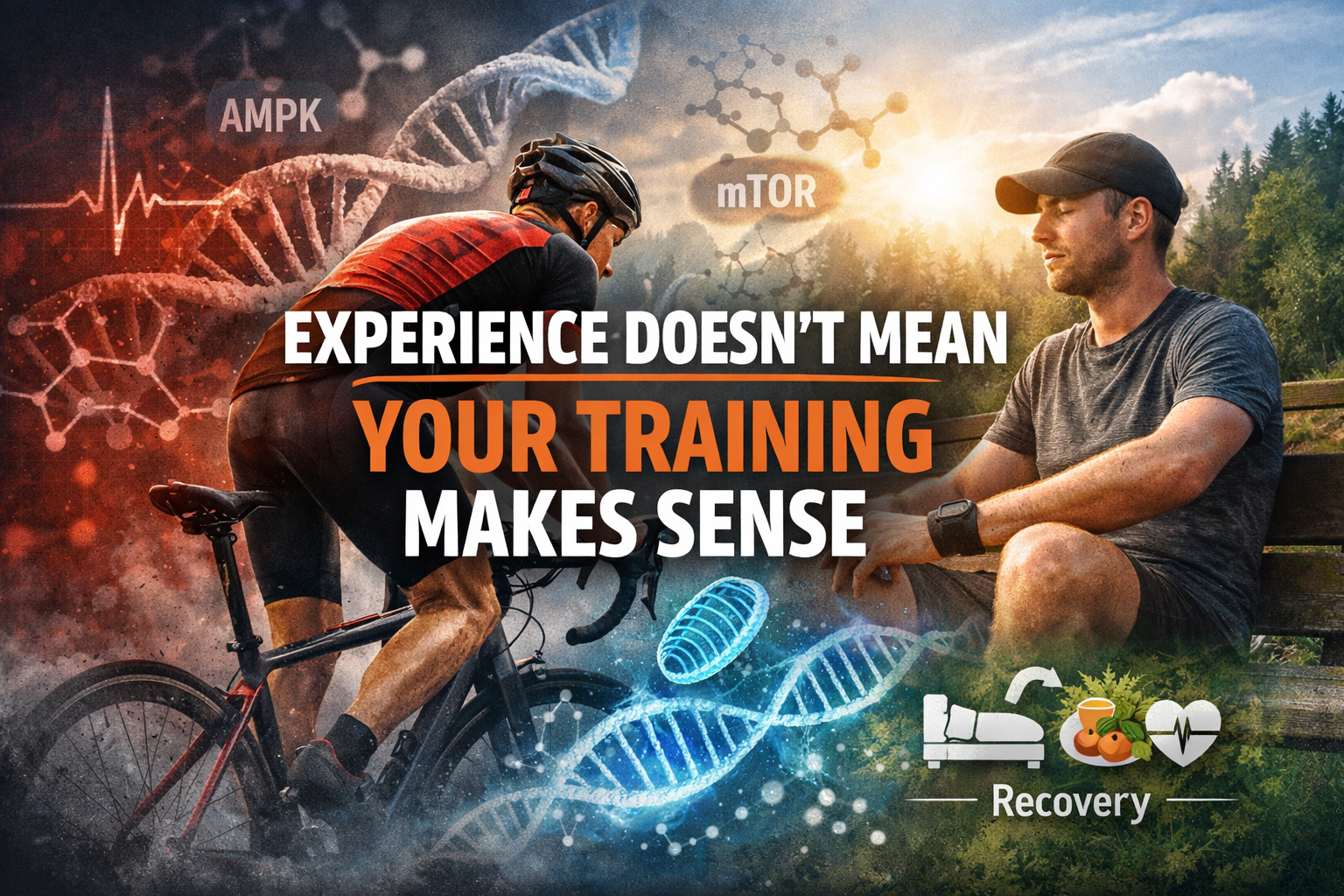
At the molecular level, this activates AMP-activated protein kinase (AMPK) — an energy-sensing enzyme that responds to metabolic stress (Hawley et al., 2014).
AMPK activation is necessary.
But it’s only the beginning.
Where endurance adaptation actually happens
Long-term aerobic gains depend on downstream signaling — particularly PGC-1α, the master regulator of mitochondrial biogenesis (Coffey & Hawley, 2007).
Here’s the key detail many cyclists miss:
PGC-1α expression peaks during recovery, not during training.
This signaling cascade is optimized when:
- Glycogen is being restored
- Cortisol levels fall
- Parasympathetic tone increases
- Sleep quality is high
In other words: when the system is calm.
When riders stack day after day of moderate stress, they:
- Keep AMPK chronically elevated
- Prolong sympathetic dominance
- Delay glycogen restoration
- Blunt full PGC-1α expression
They don’t stop training.
They blur the signal.
Why fatigue becomes silent with experience
Early in a cyclist’s development, fatigue is obvious:
- Power drops
- Heart rate spikes
- Motivation crashes
With experience, fatigue changes shape.
You learn how to function while tired.
Instead of breakdown, fatigue appears as:
- Plateaued fitness
- Fragile sensations at moderate power
- Longer warm-ups to feel “normal”
- Greater reliance on caffeine or adrenaline
This is chronic low-grade fatigue — effective at blocking adaptation while remaining easy to rationalize.
Why experienced cyclists explain fatigue away
Experience provides explanations:
- “That’s just age.”
- “It’s base season.”
- “I’ll sharpen later.”
- “I’ve done more than this before.”
Each may be partly true.
But together, they allow fatigue to accumulate quietly — because nothing feels broken.
The rider isn’t failing.
They’re just not improving.
The strength-training comparison cyclists overlook
Strength athletes understand a rule cyclists routinely violate:
Training is the stimulus. Recovery is where growth happens.
A bodybuilder lifts to:
- Disrupt muscle fibers
- Trigger anabolic signaling
- Create a clear adaptive demand
Then they aggressively protect recovery:
- Reduced movement outside training
- Low environmental stress
- Prioritized sleep
- Intentional nutrition
Why?
Because muscle growth depends on mTOR signaling, which is highly sensitive to stress (Baar, 2006).
Here’s the critical overlap:
Chronic AMPK activation interferes with mTOR signaling.
In plain terms:
- AMPK = endurance stress signal
- mTOR = growth and repair signal
Repeated endurance stress without recovery suppresses full tissue remodeling — including mitochondrial and structural upgrades.
Strength athletes respect this interference effect.
Cyclists largely ignore it.
Cyclists create the signal — then interrupt it
An experienced cyclist will:
- Do a hard aerobic or threshold session
- Deplete glycogen
- Activate AMPK and PGC-1α pathways
Then:
- Ride “steady” the next day
- Ride again the day after
- Never fully reduce systemic stress
Not hard enough to create a new signal.
Not easy enough to allow recovery.
They don’t rest.
They extend the stress window.
The body stays functional — but stops investing in adaptation.
Why “easy Z2” isn’t always low stress
Cyclists justify this pattern by labeling rides as:
- Endurance
- Base
- Aerobic
- Active recovery
But if recovery is incomplete, even low-intensity riding:
- Maintains elevated cortisol
- Delays parasympathetic rebound
- Competes with glycogen restoration
- Blunts mitochondrial signaling
Low intensity does not automatically mean low stress.
Context matters.
The real cost of never protecting the adaptation window
When recovery is repeatedly interrupted:
- Fitness plateaus
- Durability declines
- Power becomes fragile
- Recovery takes longer
- Confidence erodes
The rider ends up working harder just to stay the same.
Not because they’re under-trained —
but because they’re under-recovered.
The Masters cyclist problem: when wisdom blurs training clarity
With age, many Masters cyclists gain perspective.
They become:
- Less reactive
- Less dogmatic
- More tolerant of ambiguity
- More balanced about life stress
That’s a strength in life.
In training, it often blurs contrast.
Instead of clear easy and hard days, training drifts into the middle:
- “This still counts as Z2”
- “I’m not smashing it”
- “It’s not that stressful”
Recovery becomes less volume, not less stress.
And with age, that distinction matters more — not less.
Why this matters more for Masters athletes
Aging shifts several physiological realities:
- Slower connective tissue remodeling (Magnusson et al., 2010)
- Reduced anabolic sensitivity (Burd et al., 2013)
- Greater autonomic sensitivity to stress (Seiler et al., 2019)
Masters athletes still adapt — but they require:
- Cleaner signals
- Clearer recovery
- Less background noise
Why metrics don’t always save you
(Masters Sidebar)
Metrics are tools — not referees.
Experienced riders often use data to justify continuation:
- HRV can remain “normal” despite accumulating muscular or connective fatigue (Plews et al., 2013).
- TSS/load metrics track workload, not tissue recovery or hormonal state.
- Resting HR may stay stable even as durability declines.
Meanwhile:
- Tendons feel “grumpy”
- Small injuries linger
- Fatigue never quite resolves
These are not signs of weakness.
They’re signs of interrupted recovery biology.
If something hasn’t healed in weeks, it’s not bad luck — it’s usually unresolved stress.
What experience is supposed to give you
Experience shouldn’t make you tougher.
It should make you more selective.
More aware of:
- When effort matters
- When restraint matters
- When fatigue is productive
- When it’s just noise
The strongest experienced riders aren’t the ones who train the hardest.
They’re the ones whose training adds up.
Final thought
Experience doesn’t protect you from mistakes.
It just makes the mistakes feel justified.
If riding feels harder than it should — if fitness feels fragile instead of durable — don’t assume you’ve lost something.
Assume your training no longer makes sense.
And fix that.
Fuel your next breakthrough. Don’t miss new insights, workouts, and the launch of SMART Cycling.
Leave a Reply