
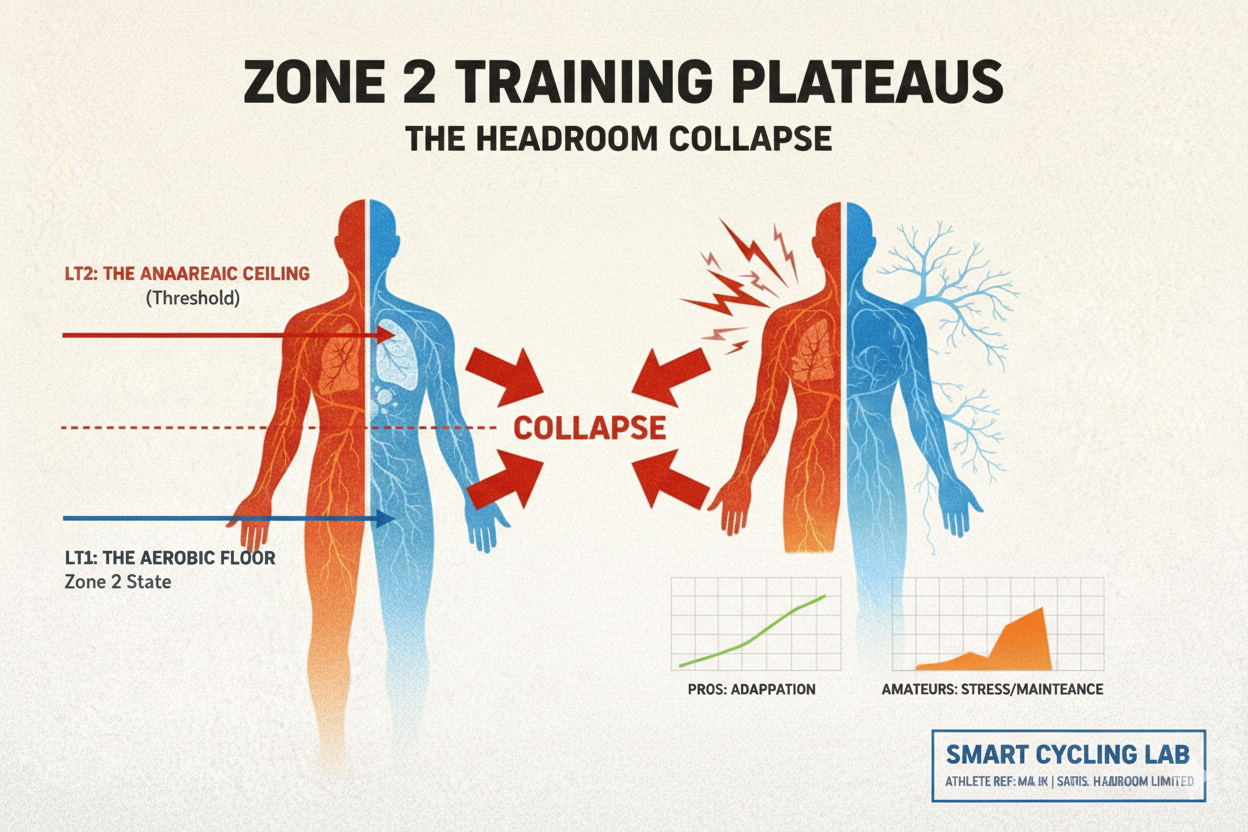
Zone 2 Needs Space Above It — Why It Elevates Some Pros, Breaks Others, and Traps Amateurs in Maintenance.
Zone 2 has become the most discussed training zone in cycling — and also the most misunderstood. What was once a vague concept of “endurance riding” has evolved into something far more precise: a zone defined by metabolic control, autonomic calm, and restraint rather than effort.
Quick Summary: Zone 2 training plateaus when the gap between your Aerobic Threshold (LT1) and Anaerobic Threshold (LT2) becomes too small. Without “headroom” created by high-intensity intervals, Zone 2 becomes a maintenance zone rather than a stimulus for adaptation.
If you haven’t yet, read Part 1: The Physiology of Safety and Part 2: Defining the Metabolic State to see how we got here.
The Hidden Architecture of Modern Zone 2
When physiologists talk about Zone 2, they’re not really talking about power. They’re describing an internal environment — one defined by controlled breathing, low stress-hormone interference, stable lactate, and parasympathetic dominance. The body is not defending itself. It is being held in a state where adaptation is allowed to occur.
Dr. Iñigo San-Millán helped popularize the idea that Zone 2 is a metabolic environment rather than a wattage target. But the modern peloton has taken this even further. Through athletes like Tadej Pogačar and through intensity-distribution research led by Stephen Seiler, one quiet truth has emerged:
Zone 2 only works when it still has a job to do.
And it only has a job to do when there is space above it.
What elite riders have mastered is not riding Zone 2 hard, but riding it without escalation. They hold power without drift. They breathe without urgency. They finish rides without borrowing from tomorrow’s recovery. In short, they preserve the internal state that makes adaptation possible.
⸻
The Pros Who Fail Zone 2 — The Headroom Collapse
Here’s the twist most amateurs never see coming: modern Zone 2 fails some pros as well.
Not because Zone 2 is flawed — but because not all athletes have the same physiological headroom above LT1.
Many pros adapt rapidly in their first year of high-precision Zone 2 work. Lactate stabilizes. Heart rate drift disappears. Fat oxidation improves. Oxygen delivery increases. The rides feel calm, controlled, and repeatable.
Then progress stops.
Not because performance drops — but because adaptation does.
LT1 rises, but LT2 and FTP sit too close above it. The metabolic gap collapses. Zone 2 no longer provides a strong enough signal to drive remodeling. It becomes a maintenance zone rather than a system-building one.
This pattern is especially common in fast-twitch or adrenergic-responder athletes — riders who produce high power easily but escalate stress quickly. Early in the season, Zone 2 works. Mid-season, it quietly stalls.
Power still looks easy.
Heart rate still looks stable.
Lactate still looks low.
But stroke volume stops improving. Mitochondrial signaling plateaus. The body has nowhere left to go.
These riders often avoid Sweet Spot and VO₂ work not because they can’t do it, but because their system never created enough metabolic room to progress into it.
Zone 2 didn’t fail them.
Their threshold sat too close for adaptation to continue.
⸻
The Amateurs Who Fail Zone 2 — Lifestyle Interference
Then there are amateurs — young racers, Masters athletes, committed cyclists balancing family, work, and training. They don’t live in recovery-controlled environments. They train in real life.
Unlike pros, amateurs don’t get stress isolation, mandatory naps, daily soft-tissue work, perfect sleep, or mental decompression as part of the training plan.
They train with work pressure. Emotional load. Interrupted sleep. Family obligations. Social stress. Inconsistent fueling. Cognitive fatigue.
The result is subtle but decisive:
Amateurs live slightly fatigued to maintain fitness — not rested enough to improve it.
And when low-grade fatigue becomes the background state of life, Zone 2 becomes almost impossible to hold in the parasympathetic environment where adaptation happens.
They’ll say,
“I rode 250 watts for three hours and it felt easy.”
But physiologically, something else is happening. Heart rate drifts. Breathing becomes louder. Muscular tension increases. Cortisol rises. Tomorrow requires recovery rather than building on today.
On paper: Zone 2.
In reality: stress without adaptation.
⸻
Athlete Types — Who Thrives and Who Plateaus
Zone 2 does not fail all athletes equally.
Slow-twitch dominant riders often thrive. Their LT1 sits far below LT2, giving them large metabolic headroom. Zone 2 stays calm. Adaptation signals remain active for months. They can repeat aerobic work without defending it, and Zone 2 becomes a genuine superpower.
Fast-twitch dominant riders face a different challenge. They produce power easily, but their nervous systems escalate quickly. For them, Zone 2 must be carefully calibrated to remain calm. Without occasional Sweet Spot or VO₂ touches every 9–12 days, Zone 2 plateaus quickly. These athletes don’t fear Zone 2 — they fear losing their ability to express power if intensity disappears entirely.
Adrenergic responders struggle most of all. Their heart rate drifts upward even when watts feel easy. Stress interference never fully shuts off. Zone 2 alone fails them not because it’s wrong, but because the autonomic system never settles enough for it to work. They need to learn clearance and control, not avoidance.
⸻
The Volume Trap — Avoidance Disguised as Discipline
This leads to the most uncomfortable truth in Part 3:
More volume is not more adaptation if it avoids the workouts that matter.
It is avoidance disguised as discipline.
Many riders add hours not to build systems, but to avoid intensity they find threatening. VO₂ work feels risky. Sweet Spot feels uncomfortable. Threshold demands commitment.
So they stay in Zone 2 — but ride it just a little too hard, just a little too stressed, just a little too often.
They call it durability.
In reality, they are maintaining fitness while avoiding progression.
Bodybuilders understand this intuitively. Muscle grows in safety, not chaos. You apply a stimulus, then recover so the system remodels. Cyclists often skip the stimulus entirely, living in a constant state where tomorrow always needs recovery — and nothing ever signals change.
⸻
The Masters Paradox
For Masters athletes, the paradox deepens.
With age comes emotional intelligence, nuance, and patience. These are strengths in life — but liabilities in training. Masters athletes negotiate with Zone 2 instead of entering it. They drift upward to feel productive. They avoid edges that feel costly.
They accumulate high Zone 2, tempo, and threshold-adjacent work that looks impressive but quietly taxes recovery.
Not because they don’t want to improve — but because improvement requires restraint, specificity, and true recovery. And amateur life often rewards fatigue far more than calm.
⸻
Closing
Zone 2 is not becoming “pro” because it got harder.
It is becoming pro because it got precise.
But precision only works when there is room above LT1 — and when life allows tomorrow to absorb today rather than recover from it.
Some pros thrive because their LT1 sits low enough to build upward. Others plateau because LT2 sits too close for Zone 2 to keep signaling change. Amateurs plateau because their lifestyle never gives the body a long enough truce to remodel at all.
Zone 2 is not a number you reach.
It is a state you enter.
And it only moves the needle when there is space above the floor.
Fuel your next breakthrough. Don’t miss new insights, workouts, and the launch of SMART Cycling.
Leave a Reply