
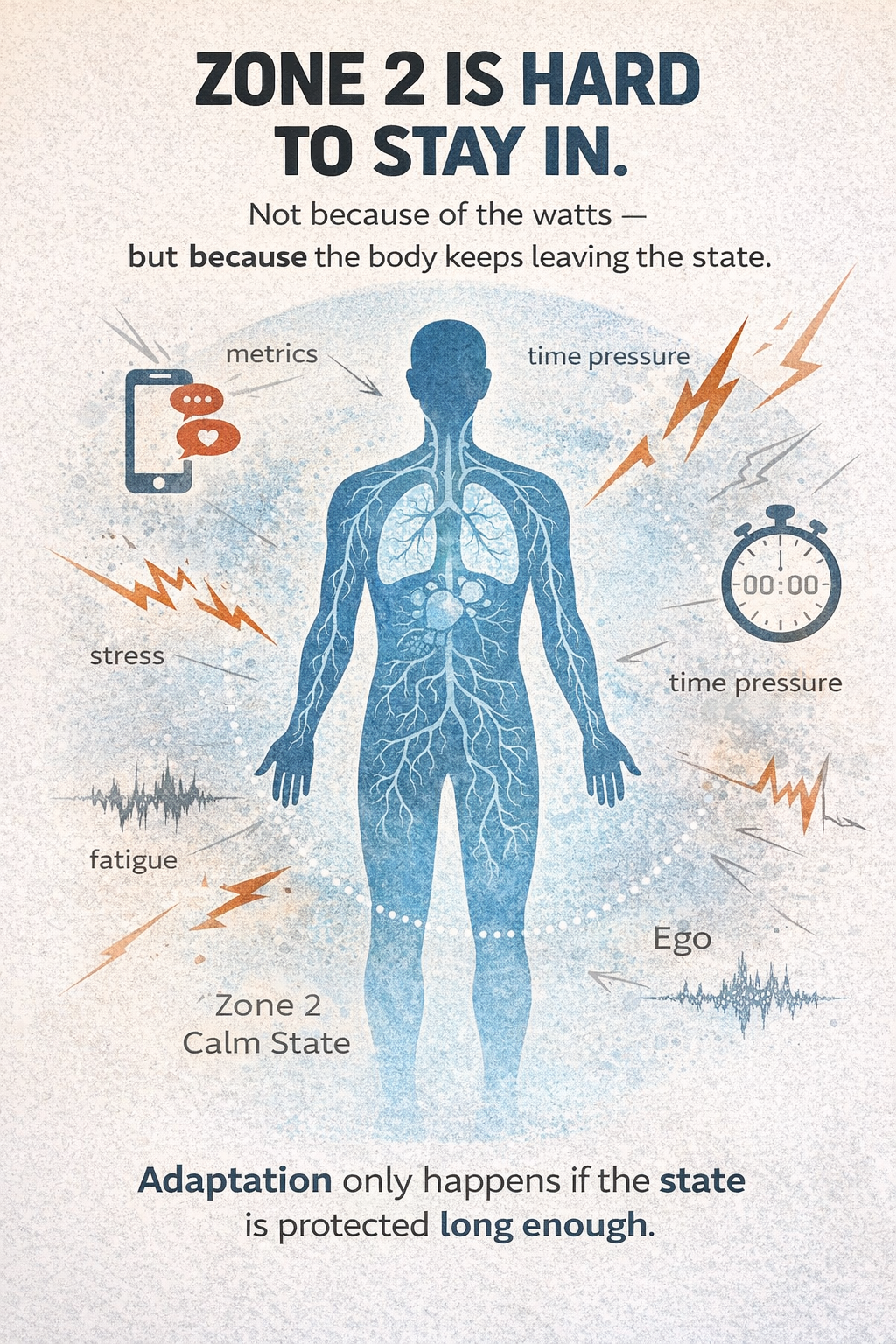
(Part 2 of “Zone 2 Isn’t a Number — It’s a State”)
Fuel your next breakthrough. Don’t miss new insights, workouts, and the launch of SMART Cycling.
If Part 1 established that Zone 2 is a metabolic environment governed by the parasympathetic nervous system, then Part 2 must answer the harder question:
Why is it so difficult for strong athletes to actually stay there?
Not ride there.
Not measure there.
But remain in the internal climate where training stress becomes training adaptation.
Strong Athletes Have a Louder Alarm System
Highly trained riders — especially those with powerful anaerobic engines and years of conditioning — often carry a system that reacts fast.
You’ve seen it in your own data: you can produce huge watts, recover quickly, and repeat hard efforts better than most. That’s a gift in racing. But in base training, that same engine can become a hair-trigger smoke alarm.
Seiler said something many riders quote, but few truly interpret correctly:
“The biggest mistake endurance athletes make is thinking every ride needs to feel productive to count.”
The subtext is not about ego.
It is about the nervous system.
A strong aerobic athlete can ride 250–270W and call it “easy,” but still be too metabolically alert to truly absorb it. The brain feels fine, but the body is not waving a white flag. It’s still scanning the horizon for threats.
Zone 2 is not the zone of maximum power you can justify.
It is the zone of minimum stress your body will accept without escalating the situation.
Common Training Mistakes — The Invisible Interference
Let’s call them out properly:
1. The Justification Drift
Riders say:
“It felt easy, so it must be Z2.”
But physiology says:
Easy is not the qualifier. Calm is.
2. The Power Creep
Athletes gravitate upward inside Z2 until it becomes:
- heavy breathing
- cardiac drift
- muscular tension
- slow recovery from the ride, not in it
3. The Misread of Durability
Riders think Z2 makes you durable because you can ride it for hours today.
But durability is not built from today’s output — it is built from the absence of internal resistance while doing it.
Z2 builds the system that makes other zones expressible.
It is not a test of what you can currently express.
4. The Under-Recovery Loop
Riders accumulate TSS, but also accumulate cortisol.
They track training, but never enter the internal environment where training becomes biological permission for growth.
Zone 2 Is a Construction Zone, But Also a Peace Treaty
Let’s expand the metaphor properly for Part 2:
- VO₂max and threshold workouts are the storm
- Zone 2 is the rebuilding phase after the storm
— but only if the nervous system stands down
You can’t rebuild a house while the fire department is still hosing it down.
And strong athletes often have the hose running by default because they’ve trained performance, but not the state where adaptation lives.
Zone 2 is the moment when the body says:
“We are not under attack. We can now remodel.”
It is a truce, a pause in stress signaling, a permission slip for cellular upgrades like:
- mitochondrial biogenesis
- increased MCT transporter expression (lactate recycling)
- capillary density expansion
- fat oxidation improvements
- stroke volume increases
- lowered resting cortisol
- hormonal rebalance
These adaptations are not dramatic to watch, but dramatic in impact later.
You don’t feel the system being built.
You feel the system when you race from it later.
How to Ride Z2 Without Waking the Dragon
Here’s the coaching-style guidance without violating safety rules:
Don’t ask:
“How high can I go and still call it Z2?”
Ask instead:
“How low can I go while still being precise enough to stimulate adaptation without triggering stress escalation?”
This is why pros and physiologists agree on signals like:
Quiet breathing
No HR drift
No muscular tension
Feels repeatable tomorrow
Mentally calm
That is the state.
The numbers are just the side-effect.
What It Should Feel Like — The Cellular Perspective
Most riders describe Zone 2 by how the brain feels.
The best riders describe it by how the body responds:
- legs feel oxygenated, not acidic
- breathing rate is low and rhythmic
- heart rate is elevated but not strained
- there is no impulse to defend, brace, or compensate
- you feel like you’re accumulating capacity, not stress
The ride should feel like a warm handshake, not a negotiation.
Because the real point of Z2 is not:
stimulating performance
It is:
stimulating adaptation.
A Quote That Matters Most
Dr. San-Millán summarized endurance adaptation better than anyone could improvise:
“The goal of training is to create an environment where lactate is cleared, reused, and recycled, not accumulated into fatigue.”
And Zone 2 — the real Z2, the state Z2 — is where that recycling system is trained without interference.
Final Message for Part 2
If Part 1 said Zone 2 is a state, then Part 2 says:
Zone 2 is not where performance is measured.
Zone 2 is where stress is negotiated into silence so adaptation can speak.
It is not a % of anything.
It is the % of time your body will tolerate training without pulling the brake on adaptation.
And that’s why the best endurance systems are not built from heroic rides, but from repeatable calm ones that never triggered the alarm.
Fuel your next breakthrough. Don’t miss new insights, workouts, and the launch of SMART Cycling.
Leave a Reply